
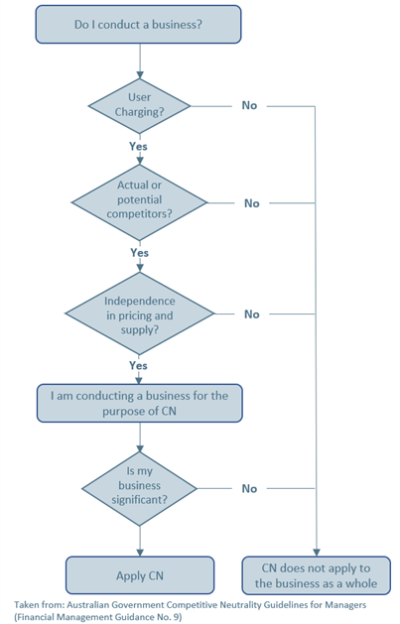
Flow chart 2: Australian Government Competitive Neutrality Guidelines for Managers: Determining if a business is subject to Competitive Neutrality Policy
To decide whether to treat a government organisation as a non-government organisation using the Document Verification Service (DVS), we need to consider the Competitive Neutrality Policy and Principles.
When publicly owned entities engage in significant business activities, resource allocation can become distorted. The purpose of the Competitive Neutrality Policy and Principles is to remove that risk. It prevents government businesses from receiving a competitive advantage simply because they are publicly owned.
These principles only apply to the business activities of publicly owned entities. They do not apply to their non-business, non-profit activities. The policy ensures we maintain competitive neutrality when offering access to the DVS.
Read the full Competitive Neutrality Policy and Principles in the Competition Principles Agreement .
Who pays the cost of providing the DVS to government organisations depends on their competitive neutrality status.
Government organisations and government-owned corporations must provide evidence of their exemption from the competitive neutrality policy to avoid incurring costs for their DVS transactions.
Government business enterprises competing against private sector organisations must pay the fees outlined in their agreement with their nominated gateway service provider, which may include the transactional fee to use the DVS.
Each government entity using the DVS is responsible for sending us evidence confirming their competitive neutrality status.
For more information on DVS transaction charges, visit our Fees page.
The following 2 flow charts explain how to decide whether an entity is considered government or non-government for DVS purposes. The second chart contains guidelines for managers.
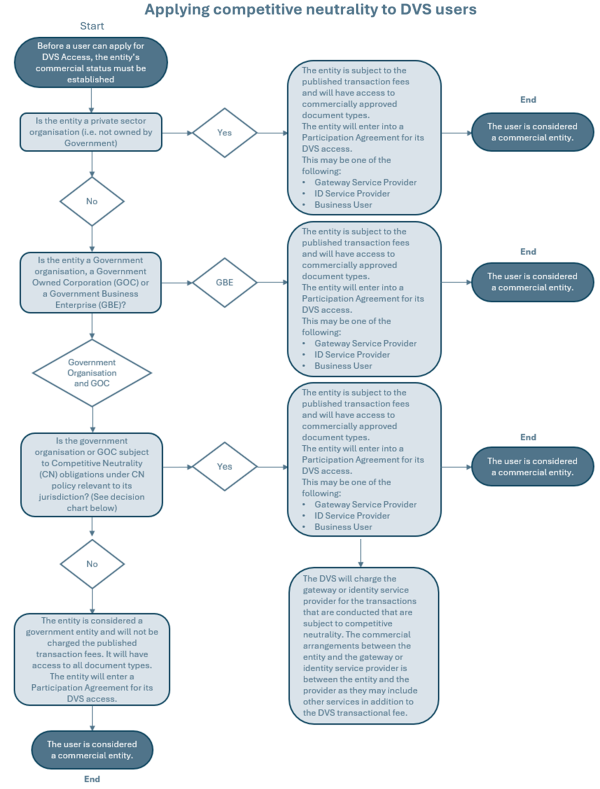
This flow chart outlines how to decide whether an entity is considered business or government for DVS purposes.
Before an entity can apply for DVS access, we need to establish their commercial status.
OR
The user is a commercial entity.
The entity is subject to the published transaction fees and will have access to commercially approved document types.
The entity will enter into a participation agreement for its DVS access. This may be in one of the following capacities:
The user is a commercial entity.
The entity is subject to the published transaction fees and will have access to commercially approved document types.
The entity will enter into one of the following participation agreements for its DVS access, depending on the nature of its intended use of the service:
If yes: the user is a commercial entity.
The entity is subject to the published transaction fees and will have access to commercially approved document types.
The entity will enter into one of the following participation agreements for its DVS access, depending on the nature of its intended use of the service:
The DVS will charge the gateway or identity service provider for transactions conducted that are subject to competitive neutrality. The gateway or identity service provider then determines how much of that cost is passed onto the entity under separate commercial arrangements, which may also cover fees for other services in addition to the DVS.
If no: the user is a government entity.
The entity will not be charged the published transaction fees. It will have access to all document types.
The entity will sign a DVS Government Requesting Agency Participation Agreement for its DVS access.
End of alternative text
This flow chart outlines how to apply competitive neutrality guidelines to understand whether your entity is subject to competitive neutrality policy.
Australian Government Competitive Neutrality Guidelines for Managers
Do I conduct a business?
Does the activity involve user charging?
If no: competitive neutrality does not apply to the business.
If yes: Does the business have actual or potential competitors?
If no: competitive neutrality does not apply to the business.
If yes: Does the business have independence with pricing and supply?
If no: competitive neutrality does not apply to the business.
If yes: I am conducting a business for the purposes of competitive neutrality.
Is my business significant?
If no: competitive neutrality does not apply to the business.
If yes: competitive neutrality applies.
End.
This flow chart was first published in the Australian Government Competitive Neutrality Guidelines for Managers.
End of alternative text