
IVS Newsletter - June 2026
On this page
Identity Verification Services Newsletter – June 2026
The IVS Newsletter is sent every 6 months to provide updates about the identity verification services (IVS) and identity-related initiatives of the Attorney-General’s Department. It also includes updates from other Commonwealth, state and territory stakeholders.
Read the IVS Newsletter – June 2026 issue below.
IVS Annual Report 2024-25
The IVS Annual Report provides information about use and operation of the IVS for each financial year. You can read the 2024-25 report at: Identity Verification Services Act 2023 Annual Report 2024–25 | Attorney-General's Department.
Key statistics for 2024-25 include:
- The Document Verification Service (DVS) was used 133,140,077 times.
- 2,228 entities used the DVS:
- 119 were government users
- 2,109 were private sector users.
- Only one government agency used the Face Verification Service (FVS). They used it 2,492,804 times.
- There were no data breaches or security incidents across all services.
- No entities were suspended from making requests through the IVS.
- No entities were terminated from making requests through the IVS.
- There were no authorised disclosures of information to prevent threats to life or death.
The IVS Annual Report 2024-25 demonstrates how the IVS is used every day by government and the private sector. It highlights that the IVS is foundational to how identity is established, verified and protected in Australia.
Updated information in the IVS Annual Report 2025-26 will be available soon on the Attorney-General's Department website.
IVS Forum 2026
The 7th IVS Forum will be held at the Hilton Hotel Sydney on 1 and 2 September 2026. This two-day event is for government and industry to hear from and engage in topics relating to identity and verification services. Please save these dates into your calendars, and ticketing details will be shared soon.
Statutory reviews of the Identity Verification Services Act 2023
The Attorney-General has commenced the statutory reviews of the Identity Verification Services Act 2023 (Cth) (IVS Act), which includes the Interim Review and the Act Review.
- The Interim Review will consider the privacy protections and security requirements in the IVS Act and associated instruments. It will also consider the penalties for non-compliance with obligations set out in participation agreements, including whether there is merit in developing a civil penalty framework for the IVS.
- The Act Review will consider the operation of the IVS Act, and the provision of the IVS more broadly.
Together, these reviews aim to ensure that the IVS framework remains relevant, fit-for-purpose and meets public expectations, by enabling the provision of effective services that protect the safe handling of personal information. The Terms of Reference set out the overarching scope, principles and specific matters to be considered.
Mr Ken Saurajen has been appointed to lead the reviews, which are scheduled to conclude by 14 June 2027.
For more information or queries, please email: ivsactreviews@ag.gov.au.
New onboarding timeframe for DVS
There is a new application timeframe for onboarding Business Users and Identity Service Providers to the DVS.
The Identity Verification Services Act 2023 (Cth) (IVS Act) commenced on 15 December 2023 and requires users of the identity verification services to be a party to a participation agreement in order to legally access the DVS. All applicants must now sign a DVS participation agreement, which must be countersigned by the Framework Administrator (the Attorney-General's Department) before access to the DVS can be approved.
The new requirement has been integrated into the standard application process. This means onboarding timeframes are now 2 to 3 weeks – allowing for applications to be assessed and approved before participation agreements are signed and access is approved.
The changes don't affect existing users who already have a participation agreement.
If you are planning to establish a new DVS connection or have any questions regarding your existing connection or participation agreement, please email the onboarding team at: ivs.manager@ag.gov.au.
Compliance reporting under the IVS Act
In accordance with the IVS Act, all users who have signed a DVS participation agreement must conduct an audit of their use of the IVS against the agreement and the DVS access policy, and report their compliance to the department each year.
We expect that all users of the IVS including GSPs to undertake a self-audit before completing a compliance statement. Completing the compliance statement without conducting a self-audit may result in misreporting. This may impact the users ongoing access to the DVS.
Compliance reporting under the new participation agreements commenced in early October 2025. To date, the department has received over 900 compliance statements from private sector and government users of the IVS. DVS Business Users and Identity Service Providers are encouraged to reach out to their Gateway Service Providers (GSP) for support when completing their compliance statement.
Key findings of the program including any suspensions and terminations are reported to the IVS Advisory Board.
Guidance materials on the IDMatch website
There is new guidance material for DVS users on the IDMatch website. This guidance supports DVS users to meet their obligations with new information provided regularly.
There is currently information on:
- compliance reporting
- how to complete a compliance statement
- the process for remediating non-compliance, including how the department manages suspension and termination of access
- your obligations on getting express consent to handle personal information, and
- how to draft a collection notice, including a template.
The guidance materials can be found at Guidance for users | IDMatch.
Information sessions for DVS Gateway Service Providers
Gateway Service Providers (GSPs) play an important role in the DVS by:
- assessing business user and identity service provider applications against the DVS Access Policy and Guidelines
- advising the department on applicant eligibility
- ensuring their users continue to meet the obligations set out in their participation agreements.
Recent changes to the DVS framework include:
- third party arrangements and appointment of Information Match Agents
- annual compliance reporting
- new consent collection requirements.
To support GSPs, the department is offering one-on-one GSP information sessions. These sessions will give GSPs an opportunity to refresh their understanding of their obligations and raise questions with the department.
GSPs who would like to arrange an education session can email ivs.manager@ag.gov.au for more information.
DVS match specifications updated
The DVS match specifications have recently been reviewed and updated with important changes to the verification notes. These updates are intended to support users when verifying documents.
Users encountering any difficulties verifying a document, are encouraged to check the DVS match specifications on the SharePoint site before seeking assistance from Gateway Service Providers or the department.
The updated match specifications are at: DVS - DVS Match Specifications - All Documents (you will need to log in). If you require access, please email: ivs.manager@ag.gov.au.
Private sector access to the FVS
The IVS Act allows private sector organisations to access the FVS after signing a participation agreement. Several GSPs have now started building their connections to the FVS in a pre-production environment. Production access will only be available once the new FVS participation agreements are finalised, which is expected to occur in the coming months.
After this, GSPs will work with their users on the FVS rollout. The department is developing communications and administrative materials to support private sector onboarding. This will closely align with DVS processes.
You can register your interest in using the FVS by completing the online form: Register your interest in using the Face Verification Service | IDMatch.
Recent initiatives strengthen national identity infrastructure
The National Strategy for Identity Resilience sets out how the Australian, state and territory governments are working together to strengthen identity infrastructure and build resilient identities. The strategy recognises that Australians need resilient identities for their safety, access to services and economic participation. Released in mid-2023, the strategy includes varied initiatives to combat identity crime by creating identities that are hard to steal and easy to restore.
The most recently delivered initiatives are:
- Updated National Identity Proofing Guidelines – the guidelines harmonise government and industry identity proofing processes to improve national consistency. The update includes the Digital ID rollout to align proofing practices, reduce data collection, prevent identity fraud, and consider alternative proofing processes for vulnerable people.
- Stage 1 of the Credential Protection Register (CPR) enhancements – the CPR protects people whose personal details have been stolen from suffering additional harm by 'locking down' the stolen credentials. Phase 1 includes a CPR web portal for document issuers to manage identity documents and respond quickly to data breaches or unlawful misuse.
Initiatives currently underway include:
- 'Strong, consistent commencement of identity records' – this initiative is improving the integrity of identity documents and providing every Australian with an accurate, up-to-date commencement of identity record. This ensures better access to government and business services and supports law enforcement and national security efforts.
- Stage 2 of the CPR – this initiative will deliver a mobile-compatible, web-based application integrated into the myGov ecosystem. Stage 2 will allow people to self-manage any credentials that can be verified through the DVS. Find out more about these Credential Protection Register enhancements below.
Both initiatives will enhance the way that Australians engage with the digital economy, while protecting against identity crime and fraud.
Credential Protection Register enhancements
The Attorney-General's Department has been busy progressing a range of enhancements to the Credential Protection Register (CPR). We are now inviting expressions of interest for involvement in the early access model for the new CPR application!
CPR overview
The CPR prevents identity documents from being verified via the DVS, while still allowing the individual to use the document for its primary purpose. For example, a passport can be blocked from being used for identity verification but still be used for overseas travel.
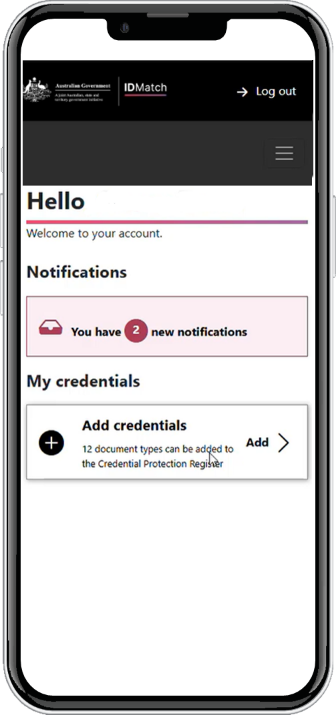
The new CPR mobile-compatible web-based application (CPR application) will be integrated into the myGov ecosystem and enable individuals to self-manage when identity documents are verifiable through the DVS. Through their myGov account, individuals will receive a notification when a DVS check has occurred on any documents they have enrolled on the CPR.
Your involvement
The CPR application will be released to an initial cohort of 1,000 individuals. Participants will be provided with early access to the CPR application to test its functionality and support materials, and provide feedback to support required improvements ahead of a full national rollout. We anticipate this will occur in late Quarter 3 2026 and run for a period of 4 weeks. If you would like to register your interest, please complete our early user application form.
Proof of Age cards added to the FVS
The addition of Proof of Age (POA) cards to the FVS marks an important milestone in creating secure and inclusive access to government services. The introduction of POA cards will allow more Australians to verify their identity digitally and securely, particularly those who may not hold a driver licence or passport.
The inclusion of POA cards within the FVS is progressing, with user acceptance testing completed. This testing validated functionality, security and end to end processes. We will release information about technical documentation and guidance to support development and onboarding activities soon. The department will continue to work with jurisdictions on their ability to provide POA data sets to enable verifications through the FVS.
This initiative enhances the reach, flexibility and effectiveness of IVS capabilities. It also upholds robust privacy, security and governance frameworks that protect individuals and maintain trust in Australia’s identity verification services.
Inclusion of POA cards in the DVS is also being explored.
Updates to the National Driver Licence Facial Recognition Solution
The National Driver Licence Facial Recognition Solution (NDLFRS) enables sharing and matching of facial recognition-based identity verification data, using driver licence images. Momentum for the NDLFRS continues to build, with South Australia and Victoria joining Western Australia in formally signing NDLFRS agreements. This is significant progress in expanding national participation in the solution.
South Australia and Victoria are now doing technical work to connect to the NDLFRS. This will enable them to upload and manage driver licence records within the platform. The jurisdictions are also preparing to sign the suite of participation agreements that allow state driver licence data to be used for facial matching through the FVS.
Other states and territories continue to consider the NDLFRS agreements and implementation approach. As jurisdictions come onboard, the NDLFRS strengthens its role as a nationally consistent, secure solution for supporting identity verification and fraud prevention across Australia.
New South Wales Digital Birth Certificate now available
The New South Wales Digital Birth Certificate (NSW DBC) is now available through the Service New South Wales app. This DBC is available for people born or adopted in New South Wales, aged 16 to 21 years old. They must also hold a New South Wales Photo Card or driver licence.
The NSW DBC is a safe and convenient way to prove identity. It shows the same information that is available on a paper birth certificate. The NSW DBC is an optional, digital birth certificate and does not replace the paper birth certificate.
In 2022, legislation was passed in New South Wales that ensures that DBCs are as legally valid as paper birth certificates.
The NSW DBC can be verified though the DVS in the same way as a paper birth certificate.
For more information visit: NSW Digital Birth Certificate for business | Service NSW.
South Australia updates customer name recording for driver licences
The South Australian Department for Infrastructure and Transport (DIT) has updated the way it records names for people who have a single name (that is, they don’t have a first name or surname). The change aligns South Australia with other road agencies across Australia. This ensures greater national consistency and improves data quality when customer information is shared or verified across jurisdictions.
Previously, South Australia recorded a dot (.) in the surname field of its licensing systems for people with only one name. Now, the customer’s full name will be recorded in the surname field when no formal surname or first name exists. This is how other jurisdictions manage similar records.
DIT has applied the change to existing customer records. Affected customers will see their updated name immediately on their South Australian digital driver’s licence. Physical cards will be updated automatically the next time a licence is renewed or replaced. This means some physical cards will continue to display a dot in the surname field. These cards are still valid licences and can still be used for identity verification purposes, including through the DVS.
Customers do not need to take any action because of the update.
IVS systems overview
About our services
The IVS helps organisations verify a person’s identity in a way that is secure, fast and private.
This makes it easier and more convenient for individuals to access government and other services. It also means that more services can be provided completely online.
The IVS compares the personal information on an identity document against existing government records, such as passports, driver licences and birth certificates.
The services are provided through secure online systems that operate 24 hours a day, 7 days a week.
IVS hubs
The IVS hubs are technical systems that act as routers. They securely transmit requests between the organisation using the service and the agency that holds the original identity document being used for verification.
These hubs do not store or retain identity information. They only retain transactional data for a limited period for auditing purposes.
Document Verification Services (DVS)
The DVS checks whether the biographic information on identity documents matches the original record. The result is simply ‘yes’ or ‘no’. This can only occur with an individual’s consent.
The DVS:
- does not check facial images
- makes it harder for people to use fake identity documents.
Both the public and private sector use the DVS, which has been operational since 2009.
Face Verification Service (FVS)
The FVS compares a photo of a person against the image used on their identity documents. This can only occur with the individual’s consent.
The FVS:
- makes it more convenient for customers to access government services by avoiding the need to attend a shopfront
- provides strong privacy, security and oversight to online biometric identity verification
- helps prevent identity theft by detecting fraudulent documents that use stolen identity information.
The FVS is currently used by Australian Government agencies.
State and territory governments have the option to use the FVS once a participation agreement is in place. Participation agreements outline strong privacy, security and oversight requirements for them to access the services, including for the expressed consent of individuals.
You can register your interest in using the FVS by completing the online form at: Register your interest in using the Face Verification Service | IDMatch.
National Driver Licence Facial Recognition Solution (NDLFRS)
The NDLFRS supports the FVS. With agreement from the states and territories, the NDLFRS will let people use a state or territory driver licence or photo ID, such as a proof of age card, to biometrically verify their identity through the FVS.
The NDLFRS centrally stores biometric templates created from facial images provided by states and territories. State and territory road agencies are gradually coming onboard and providing driver licence photos and related identity information to the NDLFRS. This is done under the authority of state and territory laws that permit this type of information sharing.
The Attorney-General’s Department manages this system on behalf of all states and territories. Each road agency retains control over the facial images and other identity information associated with their driver licences.
Who can use the IVS?
While only approved Australian organisations (that are party to a participation agreement) can access the FVS, approved organisations in Australia and New Zealand can use the DVS.
Use of the services must be reasonable, necessary and proportionate to a user’s functions or activities.
The DVS is currently used by more than 2,336 government and private sector organisations.
Government organisations with a participation agreement can now access the FVS. Participation agreements that will enable private sector organisations to access the FVS will be available later in 2026.
Who decides who can use the IVS?
Any organisation that applies to access the IVS must demonstrate that their use is reasonable, necessary and proportionate to their functions or activities.
As the operator of the services, the Attorney-General’s Department may exercise discretion to allow – or not allow – an organisation’s access to the services.
If access is granted, organisations must then sign a participation agreement to access information through one (or more) of the verification services.
Participation agreements
Participation agreements are the contracts necessary for organisations to participate in the IVS. They are set up between users and the Attorney-General’s Department, in our role as the Framework Administrator.
Participation agreements:
- set out how parties request and provide IVS, including the types of identification information involved
- meet the requirements set out in sections 9, 10, 11 and 12 of the IVS Act.
Participation agreements are also supported by access policies. These policies include safeguards to protect the privacy of people whose identification information is used during an IVS request.
The safeguards generally include committing the parties to the participation agreement to comply with Privacy Act 1988 (Cth) standards or equivalent state or territory laws (even if those standards would not otherwise apply to a party).
For more information on these services, please visit: IDMatch.
Or you can email the Attorney-General’s Department at: ivs.manager@ag.gov.au.